

 Delphi
Challenges
One of the biggest technical challenges during the implementation and development of the ERP system was reconciling the dynamically changing needs of the market with the need to maintain technological continuity and solution stability.
Results
From the perspective of many years of ERP system development, the choice of Delphi technology has proven to be one of the key success factors. It has brought a number of significant benefits—both in the technological and business contexts—that would be difficult to achieve using other development tools and environments.
The greatest success of the project is the success of our clients—market leaders and leading manufacturing companies in Poland that base their key business processes on our ERP system every day. It is their trust, development, and competitive advantage that are the best proof of the effectiveness of the solution we have been creating for over 30 years.
Forterro Polska is developing its ERP system in Delphi
The Company
Since BPSC was founded in 1988, it has been developing an ERP system designed primarily for manufacturing companies across various industries, including the metal, machinery, food, and furniture sectors. In 2017, the company became part of the international Forterro Group, which provides technologies for industry.
The name change to Forterro Polska is one of the stages in the process of unifying the companies belonging to the Forterro Group and underscores their collaboration and cooperation in support of the development of manufacturing companies worldwide.
Today, Forterro is a leader in the industrial software sector, bringing together companies with up to 40 years of market experience. It has operated as the Forterro Group since 2012 and is actively present in countries with developed industrial production in Europe and around the world. Through 40 offices and regional service and development centers, employing over 1,800 people, it provides systems supporting more than 13,000 industrial enterprises. The products offered by Forterro are tailored to the specific needs of local markets and have been designed to enable companies to operate efficiently and gain a competitive edge.
Forterro Poland (formerly BPSC) creates and develops an ERP system dedicated to production companies. The solution supports the work of hundreds of enterprises in Poland, covering key areas of enterprise operation:
- Production (including APS, MRP, billing, reporting, and recording of operations)
- Logistics and warehouses
- Finance and accounting
- Personnel and wages
- Service and maintenance of traffic
- Property management
- Budgeting and controlling
- Tool economy
- Handling of projects and unit orders
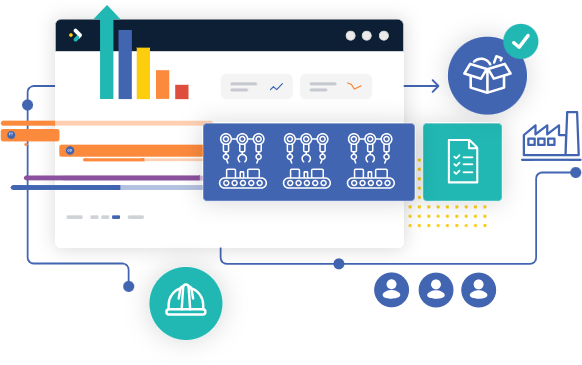
BPSC ERP covers all areas of a manufacturing company's business activities.
The Challenge
One of the biggest technical challenges during the implementation and development of the ERP system was reconciling the dynamically changing needs of the market with the need to maintain technological continuity and solution stability.
The system has been developed over decades, and Delphi technology has been the foundation of its architecture from the very beginning. Thanks to Delphi, it was possible to quickly create stable desktop applications. Over time, however, several significant challenges have emerged:
-
Maintenance and development of a large historical code base (legacy)
Code developed over many years by various teams required refactoring and adaptation to modern standards. Maintaining backward compatibility with customer data and their custom deployments was crucial, yet technically complex.
-
Integration with modern technologies and external systems
Customers now expect full integration with solutions that complement classic ERP systems, including cloud solutions. The challenge was to extend the capabilities of the Delphi platform with modern APIs, web-service support, and integration with cloud services without abandoning the existing architecture.
-
Adapting to new UX and cross-platform requirements
Changing user expectations regarding user interfaces and mobility have forced investments in modern component libraries and the development of web and mobile applications, while maintaining the core desktop client.
-
Performance and scalability when handling large data volumes
In the manufacturing industry, an ERP system often handles many thousands of documents, operations, and data from machines. Delphi allowed for code optimization and good memory management, but this required precise design and profiling of applications in real time.
-
Migrating to newer versions of Delphi without destabilizing the system
Any update to the Delphi environment carried the risk of incompatibility or changes in framework behavior. This process had to be carried out in stages, with thorough testing and a regression plan.
The Delphi Application
From the perspective of many years of ERP system development, the choice of Delphi technology has proven to be one of the key success factors. It has brought a number of significant benefits—both in the technological and business contexts—that would be difficult to achieve using other development tools and environments.
Here are the most important ones:
-
Desktop application performance and speed
Delphi enabled the creation of a very responsive and efficient desktop system, which was of great importance in an industrial environment—where large data sets are often worked on in real time. Compared to web applications or Java- or .NET-based solutions, Delphi allowed better response times and lower consumption of system resources.
-
Rapid development of functionality
Technology, especially in times of dynamic development of the functional system, has enabled rapid prototyping, testing, and implementation of new functionalities. This was crucial in the context of constant changes in legal regulations (e.g., taxes, declarations), industry requirements, and individual customer needs.
-
Technological stability and long code life
Delphi provided exceptional platform stability. For many years the system was developed continuously, without the need to frequently change the underlying technology. This made it possible to maintain continuity of development, reduce migration costs, and protect investments in code, much of which remains relevant today.
-
Strong support for modular architecture and large systems
Opinion about Delphi in one sentence:
Delphi has allowed us to create a stable and efficient ERP system that has supported Polish industry leaders for over 30 years, combining reliability with continuous development and a modern approach to technology.
Although Delphi is sometimes perceived as a “desktop” technology, it allows the design and development of large, complex systems with rich business logic, multi-layered architecture, and a high level of configurability. This perfectly fits the needs of an ERP system for industry.
-
A rich ecosystem of components and tools
Availability of mature and efficient component libraries (e.g., DevExpress), as well as the ability to build custom frameworks, significantly accelerated and facilitated development. Many of these components had no equivalents in other environments with comparable levels of quality and integration.
-
Low barrier to entry for the team and good code readability
Delphi syntax is readable, is easy to learn, and helps maintain high-quality code. This made it easier to train new team members and transfer knowledge within the company.
To sum up: The choice of Delphi as the main technology enabled BPSC to create an ERP system that, despite its thirty years of history, still remains technologically relevant, efficient, and competitive. For industrial systems that need to combine reliability with flexibility, Delphi has proven to be a good choice—and continues to do the job.
What do you appreciate most about the Delphi environment?What we appreciate most about the Delphi environment is its stability, backward compatibility, and flexibility, which allow us to develop an ERP system for decades without interrupting customer business continuity.
Key features
The BPSC ERP system covers all key areas of the company's operations—including production, logistics, finance, human resources and payroll, sales, service, and asset management—but this is only the foundation of its capabilities. Over the years, it has been expanded with a number of specialized additional modules that allow it to respond even better to the needs of industrial customers. These include modules for project management, tool management, budgeting, real cost recording, technical and economic calculation, production accounting taking into account time standards, and integrated planning. The system also has dedicated configurations for companies with service, renovation, design, or medical activities. This allows the system to be flexibly adapted to various business models—from serial to unit production and from medium-sized companies to capital groups.
Importantly, the desktop application, developed using Delphi technology, serves as the heart of the entire ERP solution ecosystem. It is surrounded by complementary web and mobile applications that provide access to selected functionalities from a browser or mobile devices—directly on the production floor, in a warehouse, or in the field. For example, there are web-based management dashboards, self-service employee portals, interfaces for submitting and accepting applications, tools for registering work and production events, and mobile solutions supporting inventory, warehouse management, and deliveries. An extensive workflow and electronic document circulation module also plays a key role, supporting the automation of business processes, providing full control over the flow of information, and integrating with all areas of the ERP system—from requisitions and orders, through invoices and personnel documents, to investment processes.
All of these elements—desktop, web, mobile applications, and workflow system—create a coherent, integrated ecosystem based on a stable and efficient platform developed in Delphi. This architecture combines the advantages of traditional desktop applications (speed, reliability, deep functionality) with the modernity, availability, and flexibility of web and mobile solutions.
Implementation process: Integrations with other systems
Implementation—understood as the ongoing maintenance and development of the system—is a process that has been ongoing for approximately 30 years. The ERP system for industry has gone from early versions, through dynamic functional development, to a modern, modular architecture supporting manufacturing companies across Poland. An important element of this path was the Delphi technology, which from the beginning formed the foundation for the application layer.
Over time, in response to market changes, the company began integrating Delphi with modern technological components—e.g., APIs, web frameworks, and reporting platforms. With Delphi updates, BPSC leveraged its new utility capabilities while maintaining backward compatibility and business continuity for its customers. Thanks to a well-organized publishing cycle, new versions of the system were delivered every year containing not only functional updates but also technological migrations (e.g., modernization of component libraries, performance fixes, or adaptations to changes in operating systems). Working closely with development teams and clients ensures uninterrupted support and business continuity. Further modules are currently being developed in a hybrid architecture, combining classic Delphi desktop applications with modern web and mobile applications. Delphi technology remains a key element, especially in areas requiring high performance and stability when working with large volumes of data.
One recently important implementation project was the premiere of the BPSC version 2024.Q4, which represents an important step in the technological and visual modernization of the ERP system. It was the biggest UI update in over a decade and an example of how Delphi technology allows BPSC to combine years of system stability with a modern approach to software design.
Version 2024.Q4 is built on the latest version of the DevExpress VCL component suite, which introduces significant improvements in performance, UI flexibility, and work ergonomics. This enabled the implementation of modern controls that significantly improved the end-user experience while maintaining consistency with existing business processes and data structures.
To approach interface modernization in a professional and thoughtful manner, an experienced team of UX/UI designers specializing in enterprise-class applications was invited to collaborate. Together, a usability audit, research, and a series of design workshops were conducted, which translated into a completely new UI concept adapted to the specific nature of work in manufacturing companies. The result was not only a change in appearance, but above all an improvement in the readability, intuitiveness, and availability of key system functions. Despite significant visual and technological changes, thanks to the flexibility of the Delphi environment and the modular architecture of our system, it was possible to introduce a new interface without the need for a revolution on the customer side, and users can still use previously known mechanisms in the new, more modern form.
On the topic of integration: dozens of them have been developed over recent years, both within standard scenarios and in the form of very advanced, individual connections. Among the most extensive are integrations with production execution systems and industrial automation, as well as production data recorders. Thanks to its open technology approach and the implementation of communication modules in Delphi, the company was able to exchange data in real time, record production operations, and synchronize production schedules with data from the factory pool. Connections to planning, maintenance (CMMS), and quality management systems were also implemented. In many cases, implementations were tailored to the unique business processes of a given plant. The BPSC ERP system also supports a number of ready-made, standard integrations that are often required regardless of industry, including integrations with courier systems—for generating labels, shipment numbers, status tracking, and support for EDI (Electronic Data Interchange)—communications with customers and suppliers for orders, delivery navigation, invoices and confirmations, or integrations with e-commerce platforms in the form of direct APIs to marketplaces or B2B systems.
Project implementation time
In the case of the ERP system in question, it is impossible to speak of a single, closed project with a clearly defined beginning and end—development has been ongoing for almost 30 years. The company operates under a continuous product development model, which means that a team of engineers, analysts, and designers constantly develops the system in response to market needs, customer needs, and technological changes.
The entire process is strictly structured and based on publishing cycles. The main versions of the system are published every 18 months—this is when key changes are delivered to users: new functionalities, interface modernizations, integrations with current versions of external systems, or technological updates (e.g., switching to a new version of Delphi or DevExpress components).
We also provide Service Packs between major releases, on average every few months. They are intended to
- improve stability,
- develop smaller but urgent functions, and
- respond to legislative and technological changes (e.g., changes in operating systems, taxes, and data exchange standards).
This structure allows for stability and predictability while enabling continuous delivery of value to customers. Importantly, Delphi technology perfectly supports this operating model, ensuring both high efficiency and backward compatibility, as well as the ability to gradually introduce modern solutions without having to build the system from scratch.
In this way, it is possible to simultaneously develop a modern, flexible product and protect the investments of the company's customers who have been working on this system for years.
Conclusion
The greatest success of the project is the success of our clients—market leaders and leading manufacturing companies in Poland that base their key business processes on our ERP system every day. It is their trust, development, and competitive advantage that are the best proof of the effectiveness of the solution we have been creating for over 30 years.
Thanks to modern components, regular technological updates, and the design of a new user interface, we have achieved:
- Increasing user productivity: Better ergonomics, speed of operation, and optimization of key screens helps users do more.
- Greater level of automation of business processes: The system integrates multiple areas of the company's operations (production, logistics, finance, and staff) into one environment.
- Reduction of the cost of living: Thanks to backward compatibility and technological continuity, customers do not have to migrate to other solutions or abandon previous investments.
- Increasing development flexibility: Modular architecture and a stable release cycle enable BPSC to quickly respond to market changes and customer needs.
Delphi technology has provided a solid foundation for creating a stable, efficient, and flexible system.
More information www.bpsc.com.pl / www.forterro.com